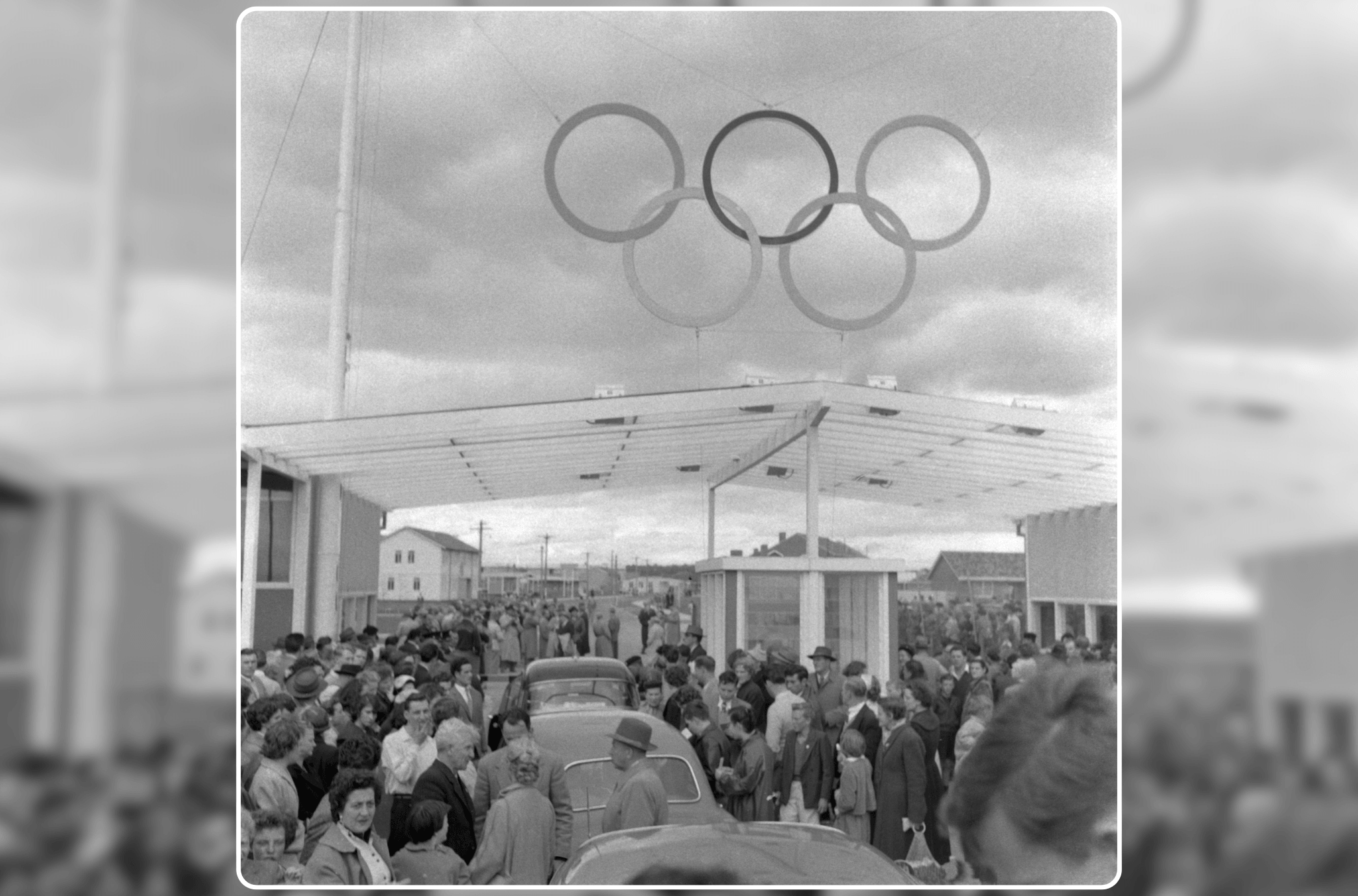
Photographer: Bruce Sharp. Image courtesy of Gymnastics NSW.
Olympic Day
Olympic Day is celebrated each year on the 23rd of June, which is the date that the International Olympic Committee (IOC) was established in 1894. The first Olympic Day was celebrated in 1948.
In 1978, the IOC added to the Olympic Charter that each National Olympic Committee (NOC) organise an Olympic Day to promote the Olympic Movement.
Olympic Day supports existing and future Olympians, by promoting the benefits of getting active and connecting with communities.
Celebrating 70 years - Melbourne 1956 Olympics
2026 marks 70 years since Australia hosted its first Olympic Games in 1956. The Melbourne Games were the first Games to be held outside of Europe or North America.
It was also the first Games to be televised. Australia received the first television broadcast on September 16, 1956, two months before the Games started. Internationally, television programming had started decades earlier; in 1936 for England, 1941 for the United States, and 1952 for Canada.
As the first Games to be broadcast, Melbourne set an important precedent for film rights and permissions. Despite protest from stations who lobbied for the Games to be classified as news (and therefore, no rights paid), it was ultimately decided that rights would be paid for.
A Golden Games
Australia rose to third on the medal tally with a total of 35 medals, including 13 gold. Dawn Fraser, Murray Rose, Betty Cuthbert and Shirley Strickland made history with their wins and are now household names in Australian sporting lore.
The 1956 Games remained Australia’s best medal tally until Sydney 2000, where Australia achieved 16 gold with 58 medals in total. At the Paris 2024 Games, Australia bested their tally for gold with 18 medals (53 in total) and finished fourth on the medal tally.
‘The Friendly Games’
Affectionately endorsed as the ‘Friendly Games’, the 1956 Olympics were held against the backdrop of multiple geopolitical tensions, including the Cold War (1947-1991), the Suez Crisis (1956), and the Hungarian Revolution (1956).
Some countries boycotted the Games, and some countries told their athletes not to interact with other athletes in the Olympic Village.
Tensions ultimately came to a head at a violent water polo match between Russia and Hungary. The police intervened and the match had to be cancelled.
Two days before the Closing Ceremony, an Australian schoolboy, John Ian Wing, wrote an anonymous letter to the IOC with an idea for the Closing Ceremony. Instead of having all countries walk separately into the stadium, Wing suggested the athletes walk together as one, in a symbol of unity. Eager to see if his idea was adopted, Wing watched the Closing Ceremony from a television set in a shop window and was overjoyed to see the athletes forming one unified group. To this day, the Closing Ceremony follows this format.
On display now – Melbourne 1956 Olympic Torch
The torch from the 1956 Games is currently on display at the NSW Hall of Champions.
The torch is featured in the exhibition Gymnastics: the Art of Sport. Australia had its first Artistic Gymnastics teams compete at the 1956 Games. Also on display are some photographs taken by Bruce Sharp, NSW’s first Olympic gymnast. The photographs give a relaxed and candid insight into daily life at the 1956 Games.
The 1956 torch was modelled on the design for the previous Games; London 1948. The 1948 Games were the first Games after World War II, and as such, the design was favoured for its cost-effective use of materials.
The torch was designed by NSW-born Ralph Lavers, an architect and illustrator known for illustrating field reports on archaeological excavations.
Only 110 torches were produced for the 1956 Melbourne Olympic Games, and they were reused many times across the relay, which covered approximately 20 470km (including air travel). In comparison to more recent Games, there were a total of 2000 torches produced for Paris 2024, and 10 000 for Tokyo 2020.
The NSW Hall of Champions includes a diverse range of 126 years of Olympic memorabilia from 1900 to now. This Olympic Day, celebrate our Olympians with a visit to Sydney Olympic Park and the NSW Hall of Champions. Find out more and search the Roll of Honour.